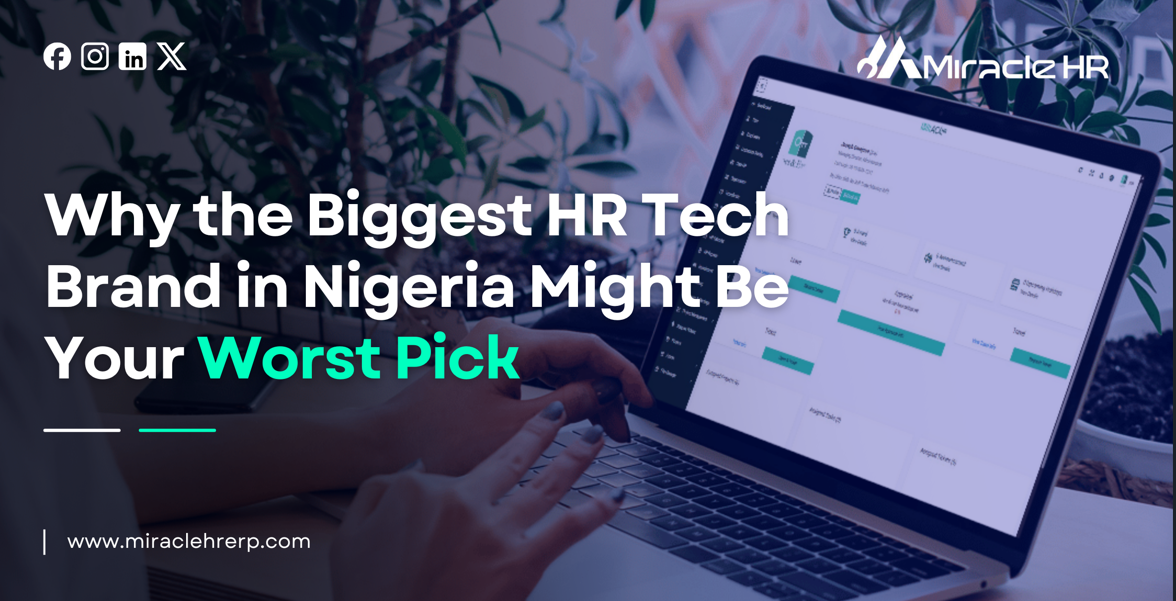
What You Should Never Do When Selecting HR Tech in
Nigeria: Follow the Biggest Brand Name Blindly
Why Smart CEOs and HR Leaders Are Choosing Fit Over Fame
In today’s HR technology world, it’s tempting — almost
automatic — to assume that the biggest name equals the best
choice. This thinking has led countless Nigerian companies into expensive
contracts with software that doesn’t solve their most pressing HR problems.
Let’s be clear: Brand recognition is not the same as
business suitability.
Whether you’re managing 30 employees or 3,000, blindly
selecting a popular HR system because “everyone uses it” could be the costliest
mistake your company makes this year — especially in a market like Nigeria
where context, local support, and affordability matter just as much as
features.
Why “Big Name Bias”
Fails Nigerian Businesses
Here’s the flaw in assuming big = better:
- Over-Engineering:
Many global HR platforms are built for rigid, large-scale enterprises.
They come stacked with modules Nigerian SMEs will never use — but still must
pay for.
- Low Localization:
These tools often lack support for local payroll structures, tax systems,
employee policies, or Nigerian employment laws.
- Delayed
Customer Support: You’re in Lagos, their support center is in San
Francisco. Good luck getting answers fast.
- Zero
Flexibility: Giant systems are less likely to adapt to the realities of
your business, budget, or process flow.
👉 So why do so many
companies still choose them? Fear. Peer pressure. Or because “it's what the
industry leaders use.”
But here’s the truth: industry leaders have different
problems, budgets, and team sizes from you.
✅ What Smart HR Leaders Look For
Instead
To help you avoid the brand trap, here are five things to
prioritise beyond the logo:
1. Alignment with Your Unique HR Challenges
Before selecting tech, ask your team:
“What HR bottlenecks do we need to fix in the next 6 months?”
Time tracking? Leave management? Onboarding?
Choose tech based on your REAL pain points, not future possibilities you aren’t
ready for.
2. Local Fit & Compliance
Does the HR platform support Nigerian payroll tables?
Pension rules? Secured employee data storage required by NCC or NDPR?
If not, your HR team will end up doing a lot of manual work — defeating the
purpose.
3. Scalability Without Overpayment
Avoid software that forces you to buy 400 features to
use 7. A great HR platform grows with you, without forcing costly upgrades.
4. Support That Knows Your Context
Can you get same-day support? Can you speak to someone who
understands salary disbursements through Nigerian banks or how to manage
NSITF/ITF/NSF compliance?
Support should help you solve actual problems — not reply “We’ll forward this
to engineering.”
5. User Experience That Employees Actually Like
Bottom line: if your employees find it difficult to log
hours, view payslips, or request leave — they won’t use it. And your investment
will sit there… unused.
💡 The Golden Rule: Solve
First, Brand Later
Your HR tech should be an enabler, not a status symbol.
If you're not solving time drain, compliance stress, payroll issues, talent
shortages, or culture gaps — it doesn't matter if you're powered by the world's
#1 system.
Start from clarity:
🔥
What do we need this software to accomplish in 90 days?
🔥
Which parts of our HR process can it eliminate or automate?
🔥
Will it reduce HR workload and improve employee experience in real,
measurable ways?
If the answer is no, the brand name isn't worth it.
How Business Leaders in
Nigeria Are Doing It Right
Forward-thinking Nigerian CEOs and HR managers are ditching
the hype and choosing platforms that provide:
- Localized
payroll and tax computation
- Fast
implementation (not 6 months… try 6 days)
- Hands-on
local support (WhatsApp included)
- Employee-first
tools that are simple to adopt
It's about fit, not fame.
Further Readings:
Final Takeaway for Leaders
When selecting HR tech, don’t be impressed — be strategic.
Your best move isn’t to copy the big player. It’s to choose a solution
that matches your pain points, people, process, and payroll realities.
Smart leaders don’t buy “what’s trending", They buy what actually works.
 Preview Post